
Equity benchmarks pared initial gains to end lower on Friday, recording their third day of decline, amid weak trend in IT counters. The 30-share BSE Sensex tumbled 452.90 points or 0.75 per cent to settle at 59,900.37. During the day, it tanked 683.36 points or 1.13 per cent to 59,669.91.

Banks cannot shirk their responsibility in cases of frauds.

Hena Mehta will answer Your Questions on personal finance on a weekly basis. Please mail your questions to getahead@rediff.co.in with the subject line 'Personal Finance Query' along with your name and Hena will offer his helpful advice.

Union Road Transport and Highways Minister Nitin Gadkari on Wednesday pitched for formulating a policy for using the Reserve Bank of India's rising foreign exchange reserves for funding road projects, saying the country needs low cost finance for such infrastructure projects. Addressing a virtual event organised by industry body CII, Gadkari further said that the National Highways Authority of India (NHAI) should also have a financial arm like the power ministry's Power Finance Corporation (PFC). "We have a surplus of dollar reserves in the country. I have decided to talk with the RBI Governor, about how we can formulate a policy by which we can use this foreign exchange reserves for development of infrastructure in the country," he said.

From the enactment of the capital control Act to the recognition of the BSE as a stock exchange and the infamous Harshad Mehta scam, here are the 18 biggest events for stock markets from 1947 to 1993.
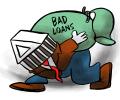
How much will the banks' bad assets grow in March? It could be anywhere between Rs 1.2 trillion and Rs 2 trillion, observes Tamal Bandyopadhyay.

Mudra Bank will be a Rs 20,000-crore institution, which would "primarily be responsible for refinancing all micro-finance institutions.
Canadian Prime Minister Justin Trudeau highlighted the importance of coordinated G20 leadership and action to uphold the rule of law and international law and strengthen democratic systems, as he participated in a virtual G20 Leaders' Summit hosted by India.

In the June quarter of FY24, 51 per cent of consumers who took small-ticket personal loans already had more than four credit products at the time of accessing yet another new loan, compared with just 17 per cent in the June quarter of FY20, points out Tamal Bandyopadhyay.

The Paris-headquartered FATF said Pakistan should continue to work on implementing its action plan to address its strategic deficiencies

Equity benchmark Sensex declined over 410 points to close below the 61,000-mark on Thursday, tracking weakness in M&M, Bajaj Finserv and Reliance Industries amid widespread selling pressure in global markets. A depreciating rupee also put pressure on domestic equities, traders said. In a subdued session, the 30-share BSE Sensex ended 419.85 points or 0.69 per cent lower at 60,613.70.

The maximum number of banks are from the US (74), followed by China (29) and South Korea (26).

Investors became richer by over Rs 2.27 lakh crore on Monday as equities rebounded, with the BSE Sensex rallying over 1 per cent amid continuous foreign fund inflows and upbeat global markets. The 30-share BSE Sensex jumped 709.96 points or 1.16 per cent to settle at 61,764.25. During the day, it zoomed 799.9 points or 1.31 per cent to 61,854.19. Following the rally, the market capitalisation of BSE-listed firms jumped by Rs 2,27,794.46 crore to Rs 2,76,06,443.06 crore.

The International Monetary Fund (IMF) warned on Tuesday that India's general government debt (comprising both central and state government debt) could exceed 100 per cent of gross domestic product (GDP) in the medium term. It also cautioned that long-term debt sustainability risks are high due to the significant investment required to meet India's climate change mitigation targets. The Indian government, however, disagreed, arguing that risks from sovereign debt are extremely limited as it is predominantly denominated in domestic currency.

Kotak Mahindra Bank was the biggest loser from the Sensex pack, skidding 1.83 per cent, followed by Axis Bank, NTPC, Hindustan Unilever, ICICI Bank, Bharti Airtel, Reliance Industries, HCL Technologies, IndusInd Bank and Nestle. In contrast, Bajaj Finance, Bajaj Finserv, Tech Mahindra, Tata Consultancy Services, Titan, Infosys, HDFC Bank, HDFC and ITC were the gainers.
To ease pressure due to the coronavirus lockdown, corporate have asked banks and the government for a six-month liquidity line, so that they can pay off their suppliers and employees.

Banks may become more cautious in extending loans, as more and more farmers may take loans, relying on the assurance that a debt relief commission will back them in the event of default.

Among Sensex shares, Bajaj Finserv fell the most by 4.08 per cent. Bajaj Finance declined by 3.01 per cent, Tata Steel by 2.2 per cent, Wipro by 2.09 per cent, Tata Motors by 1.96 per cent, IndusInd Bank by 1.9 per cent, SBI by 1.75 per cent, Tech Mahindra by 1.66 per cent and HCL Tech by 1.2 per cent. TCS, Infosys, Power Grid, Maruti, Reliance, HDFC twins, L&T, M&M, NTPC and Ultratech Cement were also among the losers.

Unlike any other business, banking is a turf where the captain's role is the most critical. Often a bank is defined by the personality of the CEO who runs it. Both HDFC Bank and Kotak Mahindra Bank are the creation of their CEOs, notes Tamal Bandyopadhyay.

The State Bank of India, ICICI Bank, HDFC Bank, IndusInd Bank, ABN Amro and others are all set to hardsell themselves to pravasis in the Gulf at the two-day 'NRI Money Show 2003' beginning June 27 in Dubai.

Policymakers should aspire to restore the pre-Independence environment where the rupee was trusted and used all over South Asia, in Southeast Asia, in West Asia, and in East Africa, suggests Ajay Shah.

Banks are allowed to invest up to 10 per cent of the paid-up or unit capital in Category-I or Category-II Alternative Investment Funds

Since March 31, 2022, the PSBs' market cap has risen 43.7 per cent, from Rs. 7.29 trillion to Rs. 10.47 trillion. It's time for the government, the majority owner of public sector banks, to reap the benefit of the rally in bank stocks, recommends Tamal Bandyopadhyay.

Bandhan Bank to fund SMEs, create jobs, says FM
The Washington-based Institute of International Finance on Thursday said that Indian government should reduce its role in banking system and further liberalise policies to attract more foreign direct investment.

The biggest private sector lender, are swarming the market with discounts and special offers

Losers include ONGC, Bajaj Finance, Reliance, SBI, Hero MotoCorp, ICICI Bank, L&T, Vedanta, Yes Bank and Axis Bank, falling up to 2.54 per cent. On the other hand, Tata Steel, PowerGrid, HCL Tech, Kotak Bank and Maruti were the top gainers on Sensex, rising up to 2.31 per cent.

'The focus needs to shift towards the ability to collect payments, particularly in tier-3 to tier-4 areas where acceptance is still lacking.'

A new generation of scholars -- this time, sociologists and anthropologists, who hitherto have been busy with researching social practices of primitive tribes and social structures like India's caste system -- are starting to cast their eyes on the financial sector.
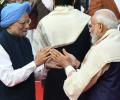
False and acrimonious debates such as Modi versus Manmohan might allow for victories that are political and partisan. But the real loser is the nation, India and Bharat, notes Arvind Subramanian, former chief economic advisor to the Modi government in its first term.

As Prime Minister Narendra Modi begins his first ever US visit, India made a pitch for listing by American and other foreign companies on Indian exchanges under the newly proposed Bharat Depository Receipts.

ONGC was the top loser in the Sensex pack, shedding 4 per cent, followed by Bharti Airtel, SBI, IndusInd Bank, NTPC, Sun Pharma and ITC. On the other hand, Bajaj Finance, Bajaj Auto, Reliance, Bajaj Finserv and Asian Paints were among the gainers.

The point made by sociologist M N Srinivas, that it represented a Sanskritic act that was linked to caste, is never raised in Indian debates and the disapproval of drink is almost universal, notes Aakar Patel.
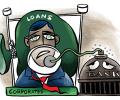
'In their over-enthusiasm to clean up the system, both the banks and the regulator should not forget that the key to the insolvency law is revival of companies -- recovery of bank dues is an offshoot of that,' points out Tamal Bandyopadhyay.
Signaling a growing clout of Indian blue chip banking scrips among foreign investors, HDFC Bank has joined ICICI Bank in the top five Sensex scrips held by foreign institutional investors
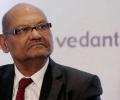
Indian lenders are unlikely to clear the vertical split of BSE-listed Vedanta Ltd in a hurry, considering that the demerger would reduce the fungibility of cash flows across businesses and increase their volatility, according to analysts. The demerger plan, which would result in six separate listed entities, would require approval from shareholders, lenders and other statutory bodies. "We believe that a separate listing of different businesses would reduce the fungibility of cash flows across businesses and increase the volatility of cash flows.

India spends significantly less on defence than could be expected from a country that faces simultaneous armed threats from two hostile neighbours -- China and Pakistan.

JSW Steel (3.37 per cent), Tata Steel (3.33 per cent), Maruti (3.24 per cent), Power Grid (3.07 per cent), IndusInd Bank (2.95 per cent), Bajaj Finance (2.12 per cent) and Tech Mahindra (2.22 per cent) were among major gainers. On the other hand, Ultratech Cement, Sun Pharma, Nestle and L&T were the losers.

The broader NSE Nifty reclaimed the key 10,000-mark and touched a high of 10,143.50 before finally settling at 10,130.65
 © 2026 Rediff.com - Advertise with us - Disclaimer - Privacy Policy - Sitemap - Feedback - About us - Terms of use - Grievances